01
On-device speech
Arabic is transcribed live with Apple’s on-device speech recognition — private, fast, and fully offline.
An iOS app that listens to the khutbah in Arabic and renders a live English translation — recognising Quran verses and Hadith on the fly, and citing them from a verified on-device corpus. Built with React Native.
For a non-Arabic speaker, the Friday sermon can pass by untranslated. Qutbah closes that gap in real time — point your phone at the khutbah and read along in English as the imam speaks.
What sets it apart is reverence for the source. When the imam recites Quran or quotes a Hadith, Qutbah doesn’t just translate the audio — it recognises the passage, pulls the canonical text and a trusted translation from an on-device corpus, and cites chapter, verse and grading. Everything runs locally, in seconds, with no connection required.
A raw translator would paraphrase a Quran verse and get it subtly wrong. Qutbah treats scripture differently: spoken Arabic is matched against the full Quran and a Hadith corpus, and when it locks on, it shows the verified verse — exact text, reference and translation — set apart on a warm scripture card.
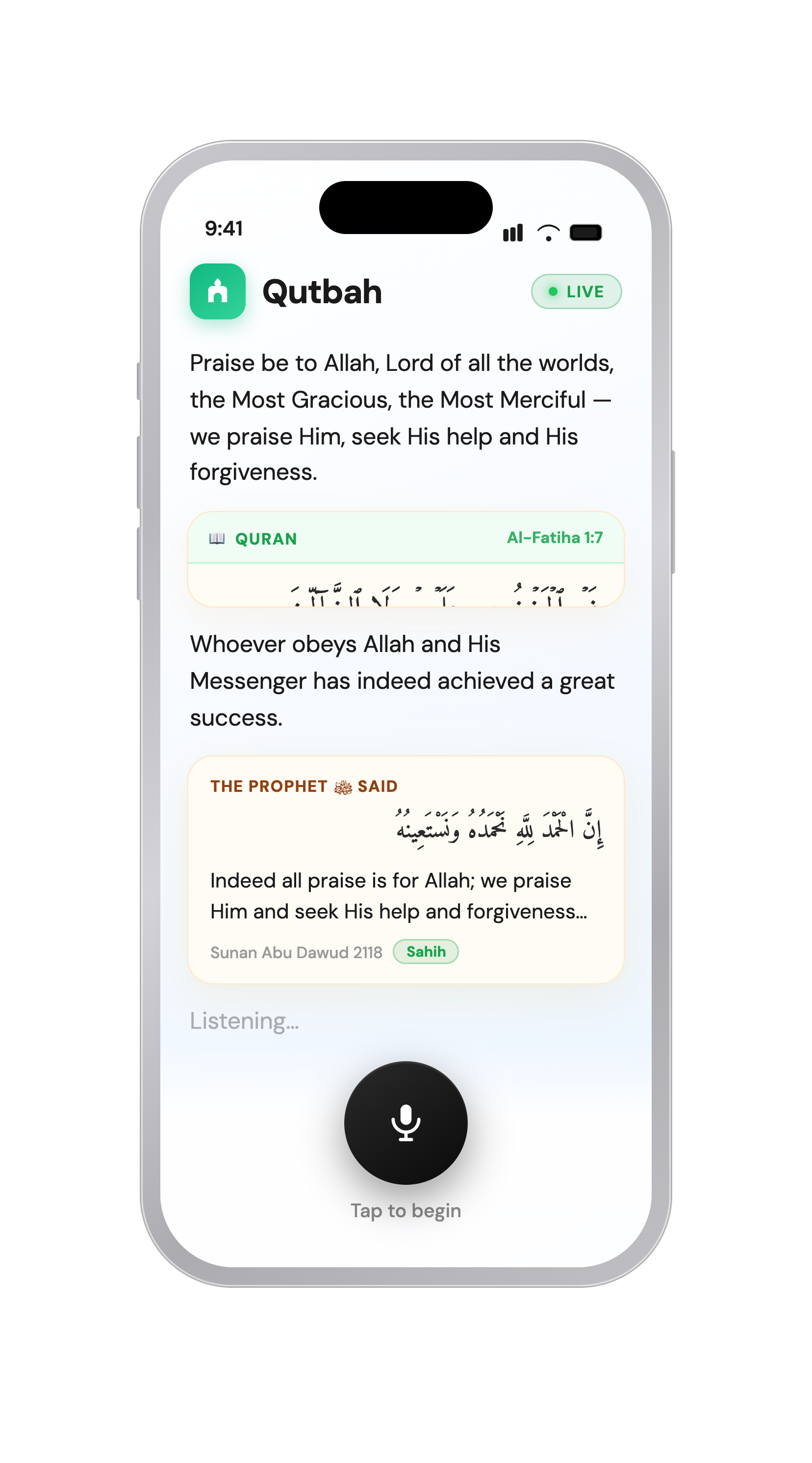
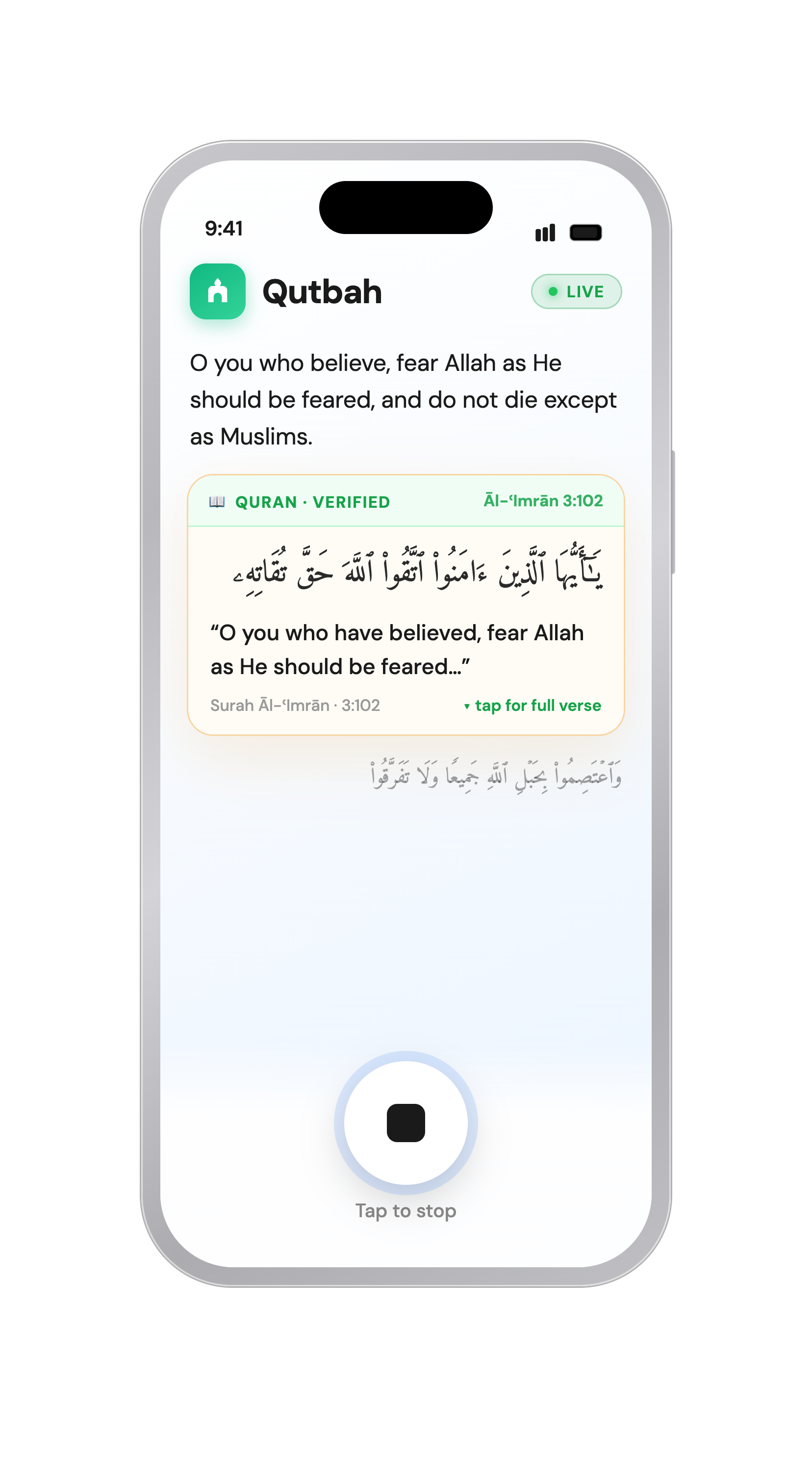
The app is intentionally quiet: a white-to-ice-blue gradient, near-black controls, and warm cream cards reserved exclusively for sacred text — so scripture is always visually distinct from ordinary speech. Arabic is set in Amiri; the interface in a clean geometric sans.
The product itself is bright and legible for use inside a mosque; the brand world around it — this case study, the marketing — runs deep navy with emerald and gold, echoing the scripture accents. Two registers, one identity.
Every colour, type ramp and radius comes from a single Material-3 token file — the source of truth the whole codebase references, so nothing is ever hard-coded.
Behind the calm screen is a multi-stage pipeline. Audio becomes text, text becomes translation, and a pair of specialists decide whether what was said is scripture — and if so, prove it.
Arabic is transcribed live with Apple’s on-device speech recognition — private, fast, and fully offline.
Candidate text is matched against all 6,236 ayahs with a composite similarity score; a high match swaps the paraphrase for the canonical verse and reference.
A specialist scans a local Hadith corpus, attributing quotes to their collection and number — with the authenticity grade (Sahih, etc.).
A final arbiter weighs the signals — translation, Quran score, Hadith confidence — and decides what to surface, so the screen never shows a guess as if it were a fact.
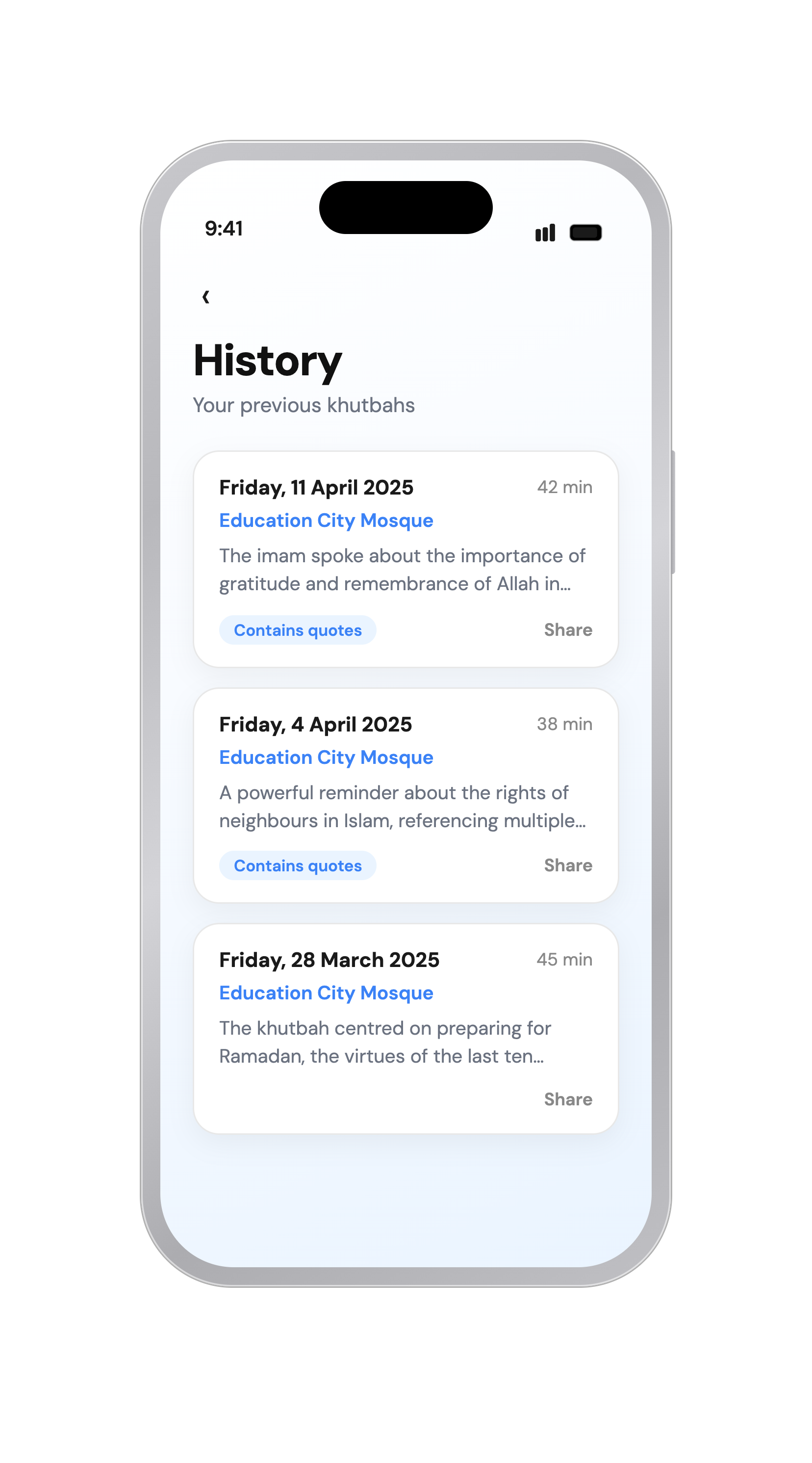
Open, tap record, and place the phone down. Translation streams in; verses and Hadith surface as they’re recognised; and every session is saved to revisit later.
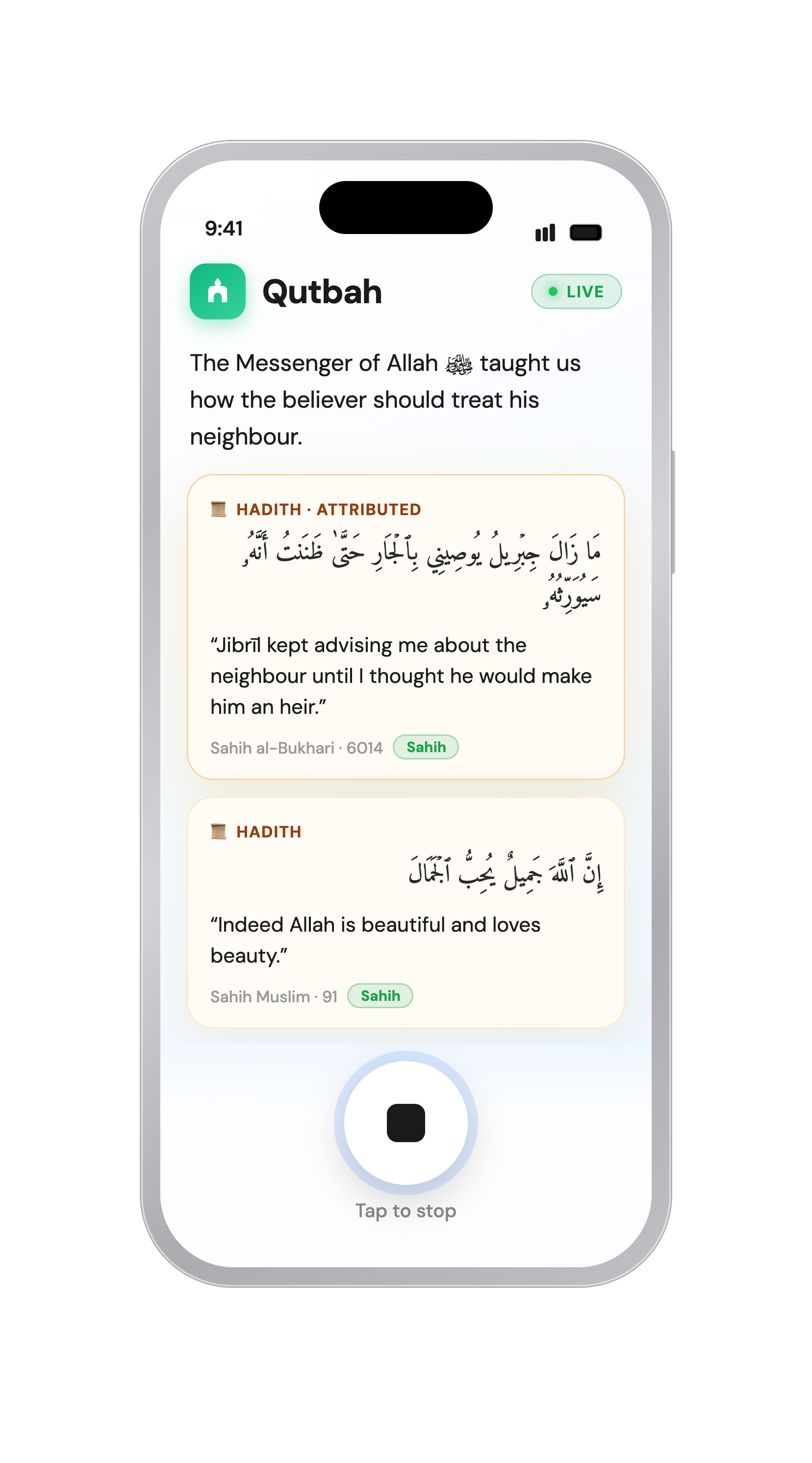
A cross-platform React Native app with the heavy lifting kept on-device: native speech, local scripture databases, and a thin LLM layer only where paraphrase is genuinely needed.
@jamsch/expo-speech-recognition streams Arabic audio into live transcript chunks on-device — no audio ever leaves the phone.
Ordinary speech is translated through a thin LLM layer (Groq LLaMA) and expo-translate, tuned for the register of a sermon and streamed in under two seconds.
A local Quran database and Hadith corpus run similarity matching with position tracking; specialists score candidates and an arbiter decides whether to show a verified verse, an attributed Hadith, or plain translation.
Sessions persist to history with their detected quotes; a Zustand store drives the live UI while everything reads from one Material-3 design-token source of truth.
An app that makes the Friday sermon accessible to anyone — without ever putting words in the imam’s mouth.
It pairs a hard real-time pipeline (on-device STT, live translation, Quran and Hadith verification, an arbiter) with an interface calm enough to read mid-prayer. The hard engineering disappears behind a single tap — which is exactly the point.